
AI courses for students in India: a parent’s guide to choosing one
Parents are catching up to AI at chat-app speed, schools at policy speed. This page is the bridge. It covers what an AI literacy course for Indian students should actually teach, what HumainChamps does, and what every Class 8-12 graduate walks out with.

Or view the HumainChamps course →

Why AI courses for Indian students are now a parent decision
CBSE has added Artificial Intelligence as an optional Skill Subject for Class IX (see the CBSE Skill Education Curriculum), and the National Education Policy 2020 calls for AI and computational thinking from middle school onward. Policy intent is there. Classroom reality is uneven: most Indian schools are still working out how to teach the subject, who teaches it, and what tools the school will allow. The home is where the gap closes.
What an AI-literate Class 8-12 student can do
- Recognise what a chatbot is and is not, and where its training data came from.
- Push back on a confident wrong answer instead of repeating it.
- Tell the difference between a real source and an invented citation.
- Use AI to extend their own thinking, not to replace it.
- Understand that what they type into a free AI tool can be used to train it.
The Humain age-band AI readiness map: what an AI course for students should cover at each age
HumainChamps enrollment is for students aged 13 and up (Class 8-12). The age bands below describe what AI literacy should look like at each developmental stage, including what to prepare for if your child is younger.
| Age band | Stage | What a child should be able to demonstrate | HumainChamps fit |
|---|---|---|---|
| 11-12 | Late primary, early middle school |
| Pre-nurture only. HumainChamps does not enrol 11-12-year-olds. This band is what to read with your child to prepare for enrolment at 13. |
| 13-15 | Middle school (Class 8-10) |
| Main cohort. HumainChamps Level 1 spans this band. |
| 16-17 | Senior school (Class 11-12) |
| Main and advanced cohorts. HumainChamps Level 2 and Level 3 extend the framework with project-heavy applications. |
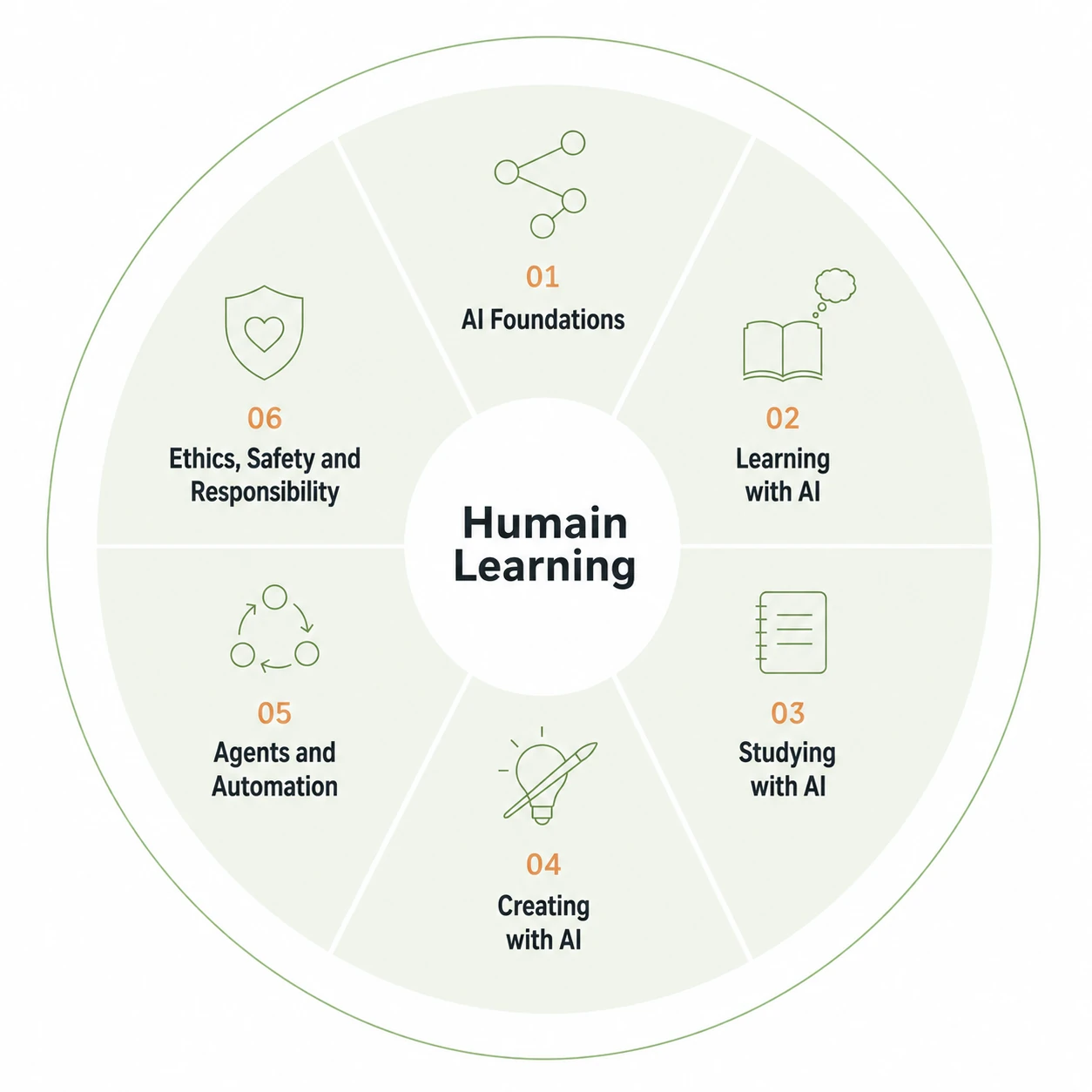
The Humain AI Literacy Framework: six pillars
The Humain framework breaks AI literacy into six pillars. Each pillar is one of the things an AI course for school students should teach explicitly, rather than leaving for the student to triangulate from YouTube. The pillars are adapted from the UNESCO AI competency frameworks, the OECD Future of Education and Skills 2030 project, and the EU Digital Education Action Plan.

Pillar 1
AI Foundations
What an AI model is, what it can and cannot do, where its training data came from.

Pillar 2
Learning with AI
Using AI as a thinking partner across subjects, not a shortcut around them.

Pillar 3
Studying with AI
Exam preparation, note-making, retrieval practice, and structured revision.

Pillar 4
Creating with AI
Text, image, audio, and video tools used with editorial intent.

Pillar 5
Agents and Automation
Multi-step AI workflows and the judgment calls they require.

Pillar 6
Ethics, Safety and Responsibility
Privacy, hallucination, disclosure, fair use, and attribution.
The parent’s AI safety conversation script: four conversations to have at home
The conversations below are calibrated to the 13-17 age band. Each one carries a parent line you can use verbatim, plus what to listen for in the answer.
1. What goes into the chatbot does not stay private.
Parent line: "Anything you type into a free AI tool can be used to train it. What's the one thing you'd never want shared?"
What to listen for: Whether your teen has thought about personal information at all. The Digital Personal Data Protection Act 2023 sets the regulatory frame; the house rule is simpler: no names, addresses, photos of classmates, or medical questions on free tools.
2. A confident wrong answer is the most dangerous kind.
Parent line: "What did the AI get wrong this week?"
What to listen for: A specific answer means your child is thinking alongside the model. "Nothing" usually means they are not catching mistakes, not that the model made none.
3. Originality has not disappeared; the disclosure rules have changed.
Parent line: "If a teacher asked, could you defend this answer line by line?"
What to listen for: Whether your teen can explain the reasoning end to end. If not, the answer is not theirs yet.
4. AI is a tool; the relationship is yours to set.
Parent line: "Are you using AI for things you're stuck on, or for things you're already good at?"
What to listen for: Which pattern your teen falls into. The first builds skill; the second atrophies it.
How HumainChamps actually runs
- Cohort size: 8 to 12 students per cohort.
- Format: live, on camera, Saturdays. Eight sessions of two hours each, sixteen hours of instruction in total.
- Tools covered: 15+ AI tools across ChatGPT, Gemini, Perplexity, Claude, NotebookLM, n8n, Runway, Krea, and Suno.
- Cost: ₹11,800 per student for Level 1, one-time fee.
- Partnership: in collaboration with E-Cell at IIT Kharagpur, including the AI Hackathon organised by E-Cell.
- Recognition: specific certification details (issuer, certificate name, public verification URL) are confirmed on the discovery call.
- Lead instructors: Rashmi Bhaskaran, Manika Jolly, and Ami Bhansali.
Full curriculum, schedule, and registration are on the HumainChamps course page.
What you get from a live AI course that you don’t get from free
The dominant pattern with free online learning is sampling, not finishing. The child gets exposed, but does not form a sustained habit.
The completion gap: research on massive open online courses puts median completion rates in the low single digits. Free YouTube plus ad-hoc ChatGPT is structurally similar: no commitment, no feedback, no completion.
Free YouTube plus ad-hoc ChatGPT
No structure, no expert, no accountability past lesson one or two.
Self-paced online courses
Better structure than YouTube. Still no live feedback. Mostly pitched at adult or US engineering audiences, not Indian 13-17-year-olds preparing for ICSE, CBSE, or a state board.
Live small-batch instruction
What HumainChamps does. The sixteen hours of live instruction is what turns sampling into a finished course.
Honest disqualifier: if your child has independently completed a 40-hour self-paced AI course in the last twelve months, structured live instruction is probably not the right fit. We will say so on the discovery call.
What every HumainChamps Level 1 graduate walks out with
- A working personal study agent, a custom GPT trained on the student’s own syllabus.
- The six-pillar framework applicable to any new AI tool that lands next year.
- A finished creative project with explicit disclosure of which parts were AI-assisted.
- Participation in the E-Cell at IIT Kharagpur partnership, including the AI Hackathon organised by E-Cell that HumainChamps students join; any recognition details (issuer, name, public verification URL) are confirmed on the discovery call.
- A parent companion guide so the conversations from the script above keep happening at home after the course ends.
Worked example
In a recent cohort, one Class 9 student spent ninety minutes of live class time building a custom GPT trained on her ICSE syllabus, tutored by one of our instructors. By the end of the session she had a midnight tutor that asked her clarifying questions back when her own prompts were unclear.
Parent FAQ
Eight of the most common parent questions. Click any question to expand the answer.
Yes for Level 1, because the goal is fluency with the framework, not coverage of every tool. Sixteen hours covers the six pillars across eight live sessions; the student then practises in their own week with the tools the cohort has demonstrated. Level 2 and Level 3 extend the same framework into deeper projects.
The fee covers sixteen hours of live small-batch instruction (8-12 students per cohort), three named instructors, participation in the E-Cell at IIT Kharagpur partnership (specific certification details confirmed on the discovery call), and a parent companion guide. Comparable live small-batch programmes in Indian metros sit in a similar band; the live, expert-led element is the structural cost.
Daily ChatGPT use without a framework usually means three patterns: copy-paste homework, single-turn questions, and missed hallucinations. The course retrains the habit. By the end, your child runs multi-turn conversations that surface gaps in their own thinking, and can explain to you why a particular AI answer is wrong.
Humain Learning runs HumainChamps in collaboration with E-Cell at IIT Kharagpur, including the AI Hackathon organised by E-Cell that HumainChamps students participate in. Specific certification details for HumainChamps Level 1 are confirmed on the discovery call.
Less, if the framework lands. Pillars 1 and 6 (Foundations and Ethics) teach a child when not to reach for the model. Pillars 2 and 3 (Learning and Studying) teach them how to keep their own thinking visible while using it. The signal that the framework has landed: your child starts catching the model's mistakes without being asked.
Cancellation and refund terms are listed on the registration page and confirmed on the discovery call before any payment is made.
Tell us during the discovery call if you are enrolling with friends or siblings; we will check current cohort availability together.
Yes if the goal is board preparation plus a working study agent inside two months. The 13-17 outcomes in the age-band map are reachable by a focused Class 12 student. The discovery call is the right place to decide whether Level 1 alone is enough for what your child needs, or whether to go straight to Level 2.
Reserve a seat in the next cohort
The discovery call covers your child’s grade, board, current AI habits, and the right level to start at. No commitment, no slide deck.
Or view the HumainChamps course →
Last reviewed: 18 May 2026.