
facebook-pixel
Menu

CBSE AI curriculum: a partnership model for Indian schools (with ICSE, IB, and state-board applicability)

For school heads evaluating how to bring structured AI literacy into your school under NEP 2020, NCF 2023, and the CBSE Skill Subject for Class IX.

Or view the HumainEducators course →

If you’re searching for the CBSE Class IX AI Skill Subject syllabus itself, the CBSE Skill Education page is the source. This page is for school heads evaluating how to deliver an AI literacy curriculum as a structured partnership, what the partnership looks like, what it costs, what we will and won’t do.
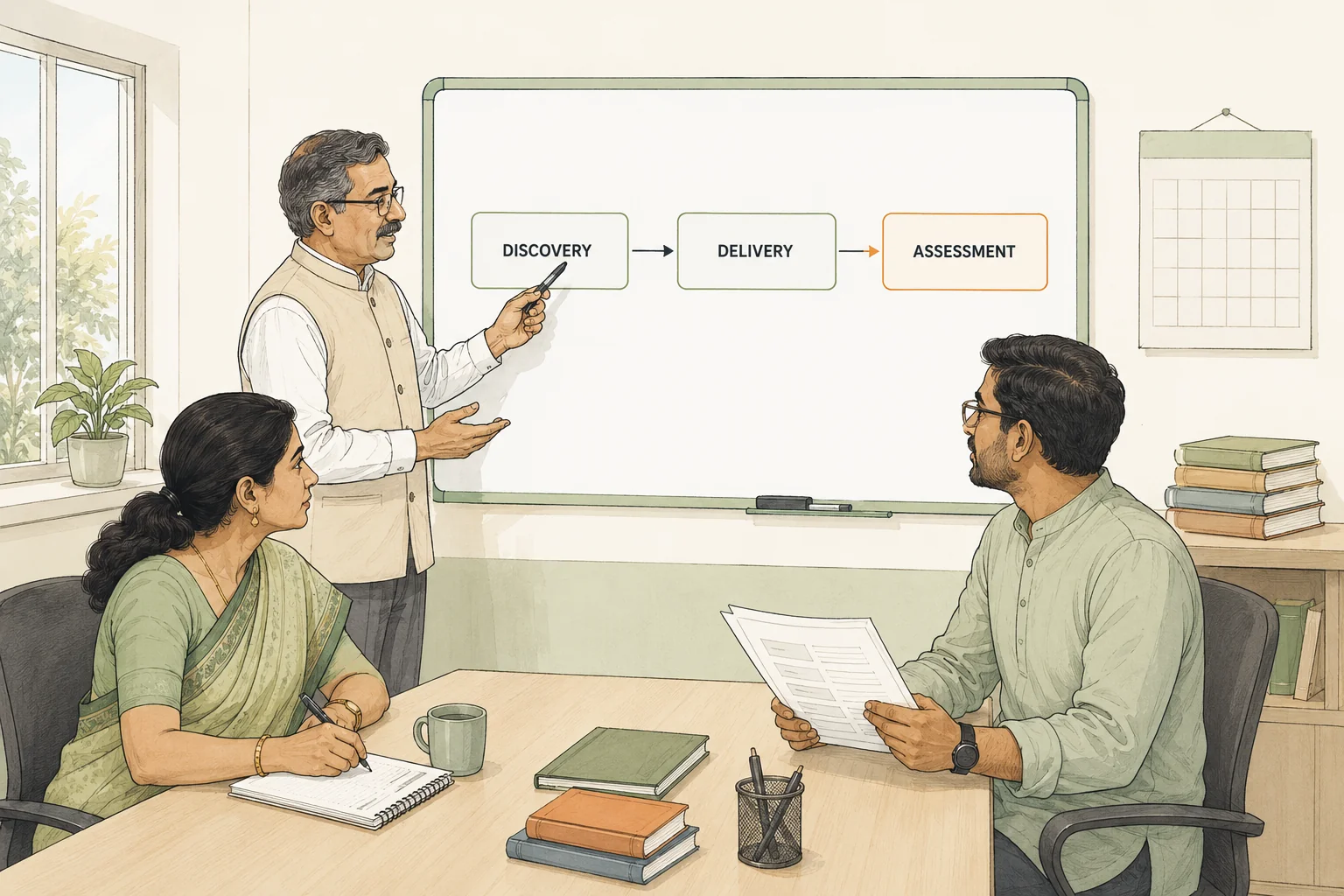
An Indian school academic-team meeting in a staff-room, with a 3-step rollout (discovery, delivery, assessment) on a whiteboard.

The CBSE AI curriculum regulatory context for Indian schools

Three policy instruments converge on the same operational question for Indian schools.

Policy instrumentWhat it sets outImplication for your school
CBSE Skill SubjectArtificial Intelligence offered as a Class IX Skill Subject.Need teaching capacity, classroom-ready content, and a board-satisfying assessment shape.
NEP 2020Coding and computational thinking from middle school onward.Middle-school AI literacy moves from optional enrichment to expected baseline.
NCF 2023Stage-wise outcomes covering digital systems literacy at middle and secondary stage.Implementation framework under NEP; pillar mapping is in the section below.

For ICSE, IB, and state-board schools, the CBSE framework is a reference point rather than a requirement. Parent and college-application expectations converge anyway: a Class 12 student applying to Indian or international universities in 2027 is assessed on the same AI-literate baseline as a CBSE graduate.

The operational question that follows is the same across all three: how do we add AI literacy without overloading our teachers or breaking the existing timetable? That is what this page answers.

Three partnership models for delivering AI curriculum in Indian schools

Schools start in the model that fits the team capacity and the time the timetable can give. Most schools move between models as their own teachers build capability.

Model A

Full curriculum partnership

HumainChamps runs as a cohort programme inside the school.

  • Sixteen hours of live instruction over eight weeks, on the day the school chooses.
  • Senior Humain instructors deliver; school teachers co-observe each session.
  • Pre- and post-cohort assessment mapped to the six-pillar framework; aligned to CBSE, ICSE, IB, or state board.
Model B

Supplementary modules

The school's IT team handles foundational digital-systems work; Humain adds the layers most IT teachers cannot deliver.

  • Four to eight hours on ethics, agents and automation, and creating with AI.
  • Slots into the existing computer-lab period.
  • Senior teachers co-observe each session.

Model C

Teacher-training-only

The school's teachers go through HumainEducators (₹8,850 per teacher) and run the curriculum themselves.

  • Humain framework, lesson templates, and assessment rubrics included.
  • Institutional discount applies at six-plus teachers.
  • Quarterly review runs in year one.

Schools typically move from Model A or B in year one to Model C in years two and three as the school’s own teachers build capability.

The 6-pillar Humain AI Literacy Framework, mapped to NCF 2023

The Humain framework is adapted from the UNESCO AI competency frameworks, the OECD Future of Education and Skills 2030 project, and the EU Digital Education Action Plan. Pillar-by-pillar mapping to NCF 2023 outcomes:

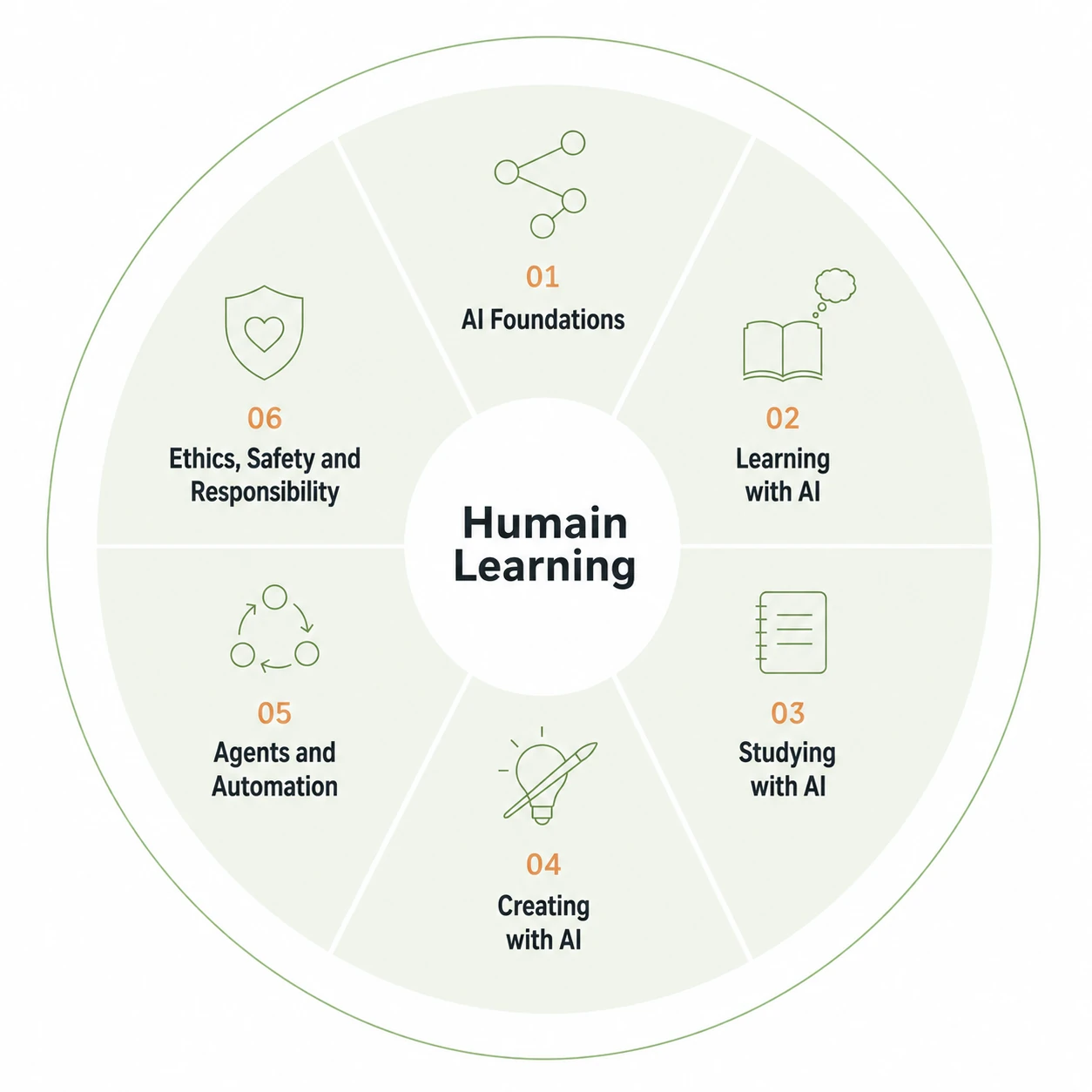
The Humain AI Literacy Framework: six-pillar wheel with AI Foundations, Learning with AI, Studying with AI, Creating with AI, Agents and Automation, and Ethics, Safety and Responsibility.
PillarWhat students learnMaps to NCF 2023
1. AI FoundationsHow an AI model is trained, where it fails, what counts as training data.Middle and secondary: critical understanding of digital systems.
2. Learning with AIAI as a thinking partner that deepens (not replaces) subject understanding.NCF pedagogy: inquiry-based learning.
3. Studying with AIBoard-aligned quiz banks, retrieval-practice feedback, college-readiness preparation.NCF assessment plus secondary academic outcomes.
4. Creating with AIHuman-first creative process with explicit disclosure of AI-assisted work.NCF art education and languages.
5. Agents and AutomationPersonal study agents, multi-step workflow design, automation judgment.NCF vocational plus computational thinking.
6. Ethics, Safety and ResponsibilityBias, privacy (DPDP framing), misinformation, deepfakes, disclosure.NCF cross-curricular: digital citizenship.

A 3-step rollout that fits inside one term

The shape below is the standard rollout. Specific dates, session counts, and academic-team responsibilities are aligned with your school at the discovery call.

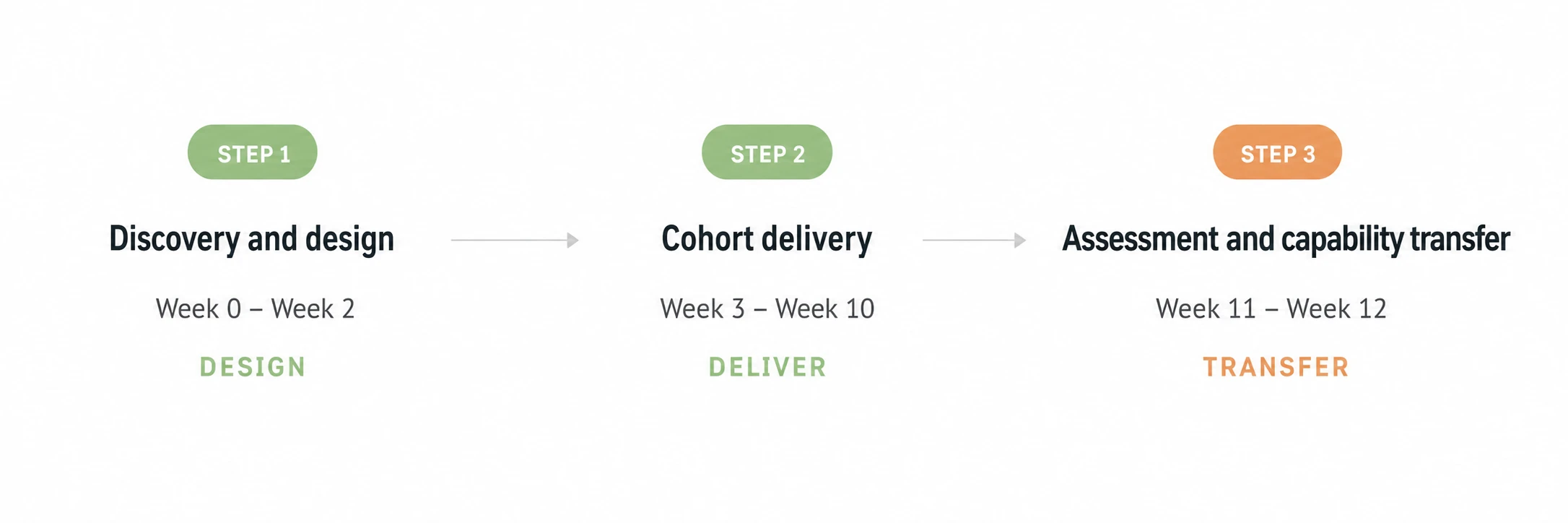
3-step rollout timeline: Discovery and design (Week 0 to 2, DESIGN), Cohort delivery (Week 3 to 10, DELIVER), Assessment and capability transfer (Week 11 to 12, TRANSFER).
  1. 1

    Discovery and design (Week 0 to Week 2)

    Ninety-minute discovery call with the school's academic team. A one-page rollout plan returned within seven working days. No commitment is required at this stage; the plan is what the school takes to its trust board.

  2. 2

    Cohort delivery (Week 3 to Week 10)

    Sixteen hours of live HumainChamps instruction (Model A) or four to eight hours of supplementary modules (Model B). Session recording, teacher co-observation, and weekly parent notes are part of the standard cohort delivery. The school sets the cadence; Humain delivers against it.

  3. 3

    Assessment and capability transfer (Week 11 to Week 12)

    Post-cohort assessment mapped to the six-pillar framework. Individual student results plus a cohort-level summary suitable for the board's annual academic review. By the end of Step 3, the school's senior teachers have observed enough live sessions to shift toward Model C in the next term if they choose.

What’s included and what’s not

The standard partnership scope. Edge-case adjustments are agreed at the discovery call.

Included

  • Live instruction by the senior Humain instructor team.
  • Full curriculum documentation, lesson plans, and assessment rubrics.
  • Parent communication templates and a weekly parent note.
  • Pre- and post-cohort assessment.
  • Consent forms and data-handling guidance designed against the Digital Personal Data Protection Act 2023 framework.
  • One academic-team review meeting per term.
  • Access to the partner-school community.

Not included (add-ons)

Hardware procurement, long-form school-policy authoring, parent town halls beyond the weekly note, curriculum customisation beyond board alignment.

What we don’t do

Replace the school’s teachers, sell AI tools to students, or lock the school into a multi-year contract.

Who runs Humain Learning

Humain Learning is operated by Eduxa Consulting. The same founding team operates the Heritage Group of Schools and I Am A Teacher (IAAT); those are the founders’ other K-12 organisations and the source of the operator experience they bring to Humain.

The team brings combined experience in school operations (Heritage Group), teacher training (IAAT), academic research (Manit and Smriti Jain, M.Ed Harvard; Dr Tapaswini Sahu, PhD JNU plus M.Phil Cambridge), and operations management (Rambabu Kondru, PGDM IIM Calcutta).

Full team profiles appear on the team page when it ships.

Pricing

Institutional pricing is structured by partnership model, grade band, and cohort size; the page publishes ranges rather than single numbers.

  • Model A (full curriculum partnership): priced per cohort. Banded range available on request.
  • Model B (supplementary modules): priced per hour of instruction delivered, minimum four hours per term. Banded range available on request.
  • Model C (teacher-training-only): HumainEducators is ₹8,850 per teacher (one-time, lifetime community access). An institutional rate applies for schools enrolling six-plus teachers.

Quotes are returned within five working days of the discovery call.

Five questions to ask any AI curriculum partner before signing

QuestionWhat a good answer looks likeHumain’s answer
Who actually teaches the live sessions?Named instructors with credentials, plus a recorded sample. Be wary of 'AI instructor' sessions that turn out to be a slide deck.Rashmi Bhaskaran (twenty-plus years in education, electrical engineering background); Manika Jolly (Google Certified Educator, AI-integrated teaching); Ami Bhansali (Scratch and STEAM teaching background). Recorded sample available on the discovery call.
How is bias and the DPDP Act 2023 handled in the curriculum?Specific consent flows and data rules, not 'we cover ethics'.Module 6 (Ethics, Safety and Responsibility) covers bias and privacy as classroom content. The partnership memo proposes DPDP-aligned consent forms and an approved-tools list as a template the school operationalises (template provision, not operating evidence from a live Humain cohort).
What happens to our teachers' role?The partner builds your team's capability, rather than your school's dependency on theirs.Models A and B include teacher co-observation; Model C is teacher-led from year one. Capability transfer is the design goal: term-by-term renewal, not multi-year lock-in.
What does the assessment look like?A sample report; attendance is not assessment.Pre- and post-cohort assessment mapped to the six-pillar framework; individual student results plus a cohort-level summary for the board's annual academic review.
What are the year-two and year-three numbers?A capability-transfer pathway, not a lock-in.Schools typically move from Model A or B in year one to Model C in years two and three. Per-student cost in Model C is lower than year one.

Frequently asked questions

Eight institutional-adoption questions school leaders ask most. Click any question to expand the answer.

The framework is board-neutral; the six pillars and the rollout work the same way under any board. CBSE alignment is the most concrete because of the Class IX Skill Subject; ICSE, IB, and state-board adaptation is tailored at the discovery call to the board's own assessment shape.

Either. By default the weekly parent note is co-branded and shipped on the school's behalf (pending operations confirmation). Schools that prefer to own parent communication entirely can take the template and run it themselves; the cohort still receives the same coverage at home.

Model B (supplementary modules) is designed for senior school. Four to eight hours layered into the existing computer-lab period covers the ethics, agents, and creating-with-AI pillars without dislodging board-exam preparation. Model A is harder to slot in Class 11-12 unless the school has built protected time for it.

Our partnership memo template proposes DPDP Act 2023-aligned consent forms, covering per-tool consent, a termly approved-tools list, and rules on student PII. The school operationalises these terms; Humain provides the template, the school provides the evidence. See the What's included section for the full design intent.

Model A is delivered in sessions of eight to twenty-five students. Below eight, the cohort dynamic stalls; above twenty-five, individual feedback gets thin. For larger sections, the school's senior teacher co-runs the session under Model A, or the cohort is split.

Yes, with parent consent for the students in that session. The discovery call is the right place to schedule the observation and align the consent paperwork.

The weekly parent note is the main lever; it shows parents what their child is doing in each session and what to ask at home. The standard shape is to pair the note with one parent town hall in week three, where the school's senior teacher walks the AI literacy aims through with parents directly.

The smallest cohort we have planned (pending live cohort delivery) is a single twenty-two-student grade in a tier-2 city school; the largest is a multi-branch trust running parallel cohorts across campuses. Both are workable; the discovery call decides which model fits the school's scale.

Book a 15-minute school demo

The discovery call covers timetable, board, starting grade, and the three partnership models. No commitment, no slide deck, no obligation.

Or view the HumainEducators course →

Last reviewed: 18 May 2026.

Humain Learning

Unlock knowledge with expert-led online courses.

Connect on Whatsapp

+91 8130023688

hi@humainlearning.ai

InstagramLinkedIn

2026 © Humain Learning. All rights reserved. Operated by Eduxa Consulting.